Sujosh Nag

I'm a computer science undergraduate at the University of New Hampshire, where I do research in the Cognitive Assistive Robotics Lab, advised by Momotaz Begum.

I work on robot learning, dynamical systems, and learning-based control. I'm interested in structured representations of dynamics and action: models a robot can learn from demonstrations, compose into new tasks, and rely on when it runs on real hardware. My experiments run on a Franka FR3, Boston Dynamics Spot, Hello Robot Stretch, and ABB YuMi.

EmailCVGoogle ScholarGitHubLinkedInXInstagram

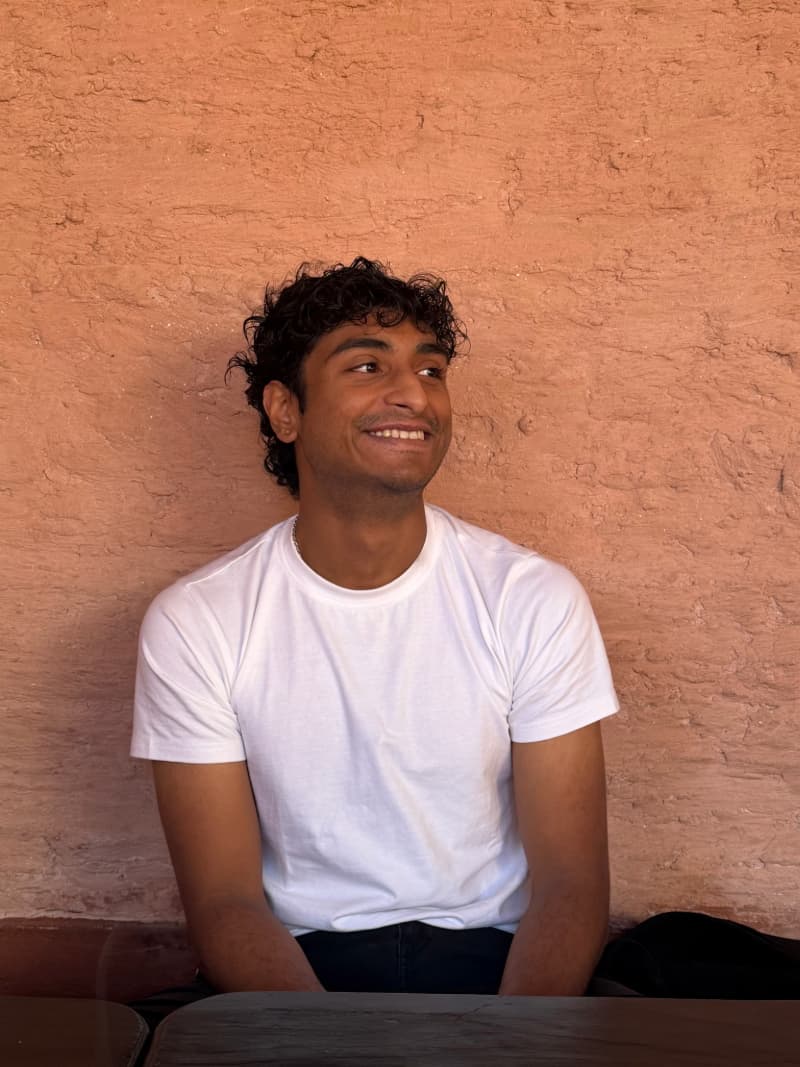
Portrait of Sujosh Nag

News

Research

Robot learning, dynamical systems, and learning-based control, with an emphasis on structured representations of dynamics and action for compositional, generalizable, and reliable autonomy.

Right now that means three threads:

Reliable generative policies

Flow- and diffusion-based visuomotor policies are expressive, but small errors compound when they run on a real robot. I work on making them precise: trajectory-level supervision for flow matching (IROS 2026), and conditioning a diffusion policy on a belief over task phase (belief-guided diffusion policy).

Structured dynamics and skills

A planner composes skills, so it needs skills that end in the right place and models of what each one does. I study where a skill boundary should fall, from the effect of the robot's action on objects (LEAP workshop, CoRL 2026), and how to plan over beliefs about symbolic state when the robot can't see everything (Belief-PDDL).

Interpretability and failure detection

When a policy fails, watching the robot rarely tells you why. I look inside vision-language-action policies with sparse autoencoders to catch a failure as it happens and name the internal concepts behind it (preprint).

Publications

Also on Google Scholar.

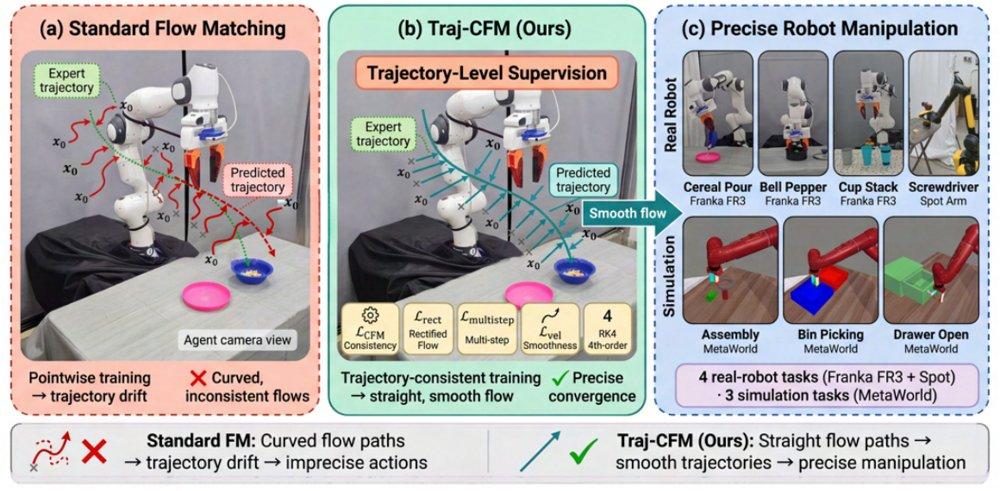
Figure from Trajectory-Consistent Flow Matching

Trajectory-Consistent Flow Matching for Robust Visuomotor Policy Learning

Riad Ahmed, Sujosh Nag, Moniruzzaman Akash, Mostafa Hussein, Momotaz Begum

IROS 2026

PDFarXiv

Summary

Flow-matching policies train on a pointwise velocity objective but integrate that field at inference, and the mismatch compounds along the trajectory. The paper adds rectified-flow regression for uniform temporal coverage, supervises the integrated displacement of trajectory segments directly, regularizes the velocity field for smoothness, and replaces Euler with fourth-order Runge-Kutta integration; the ablation shows none of the four suffices alone.

Flow Matching, Franka FR3, Spot, Point Clouds
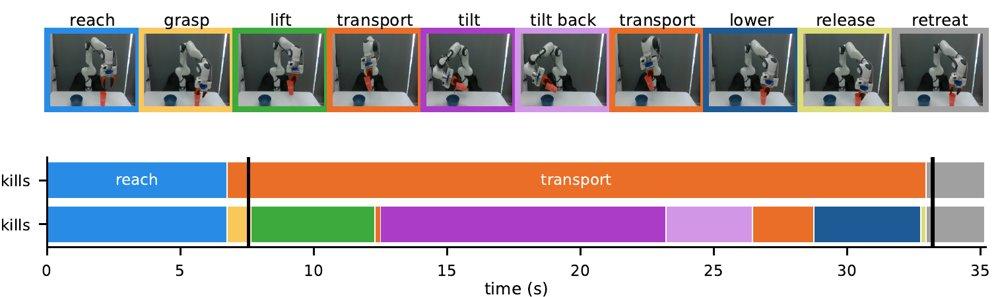
Figure from Where Should a Skill End?

Where Should a Skill End? Discovering Skills from How the Robot's Action Moves Objects

Sujosh Nag, Momotaz Begum

4th Workshop on Learning Effective Abstractions for Planning (LEAP) at CoRL 2026. Non-archival workshop paper.

PDFOpenReviewWorkshop

Summary

A planner composes skills, so a skill boundary should follow what a planner reasons about: the effect of the robot's action on objects, not appearance or arm motion, which place boundaries wherever the arm happens to move. The paper argues a skill is a recurring effect and lets out-of-sample prediction set how many there are, merging two whenever one effect model predicts held-out demonstrations as well as two, and instantiates this label-free with switched linear models of object motion conditioned on the gripper's.

Skill Discovery, Segmentation, Planning

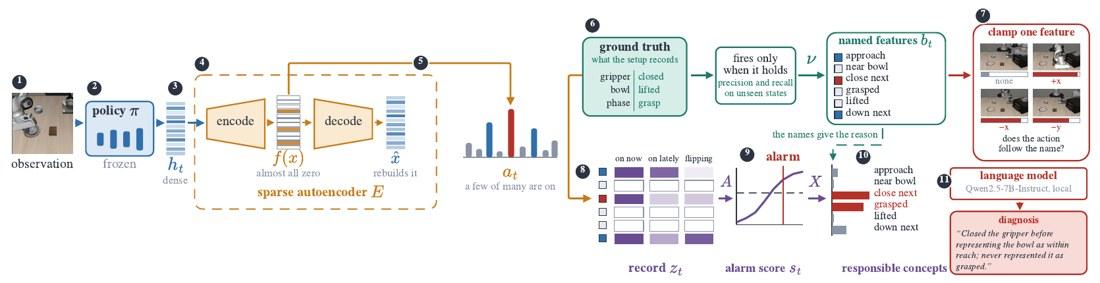
Figure from Detecting and Explaining Robot Policy Failures

Detecting and Explaining Robot Policy Failures from Sparse Internal Features

Riad Ahmed, Sujosh Nag, Moniruzzaman Akash, Momotaz Begum

Under review. arXiv preprint, 2026.

PDFarXiv

Summary

Trains a sparse autoencoder on the activations of a vision-language-action policy and names each basis feature by a manipulation concept that holds whenever it fires, keeping only names that stay precise on unseen initial states and on an unseen task and that survive a closed-loop clamp confirming the policy acts through the feature. A run-time monitor over those same features flags a failing execution and names the internal quantities responsible.

Interpretability, Sparse Autoencoders, VLA, Failure Detection

Research projects

Independent work and research done in courses.

Independent research

Structured Belief-Guided Diffusion Policy

Conditioned a diffusion policy on a belief over task phase and progress predicted from image observations, taking as given the skill boundaries that define those phases. The belief helped in Meta-World and on real Franka tasks, yet under temporal perturbation the policy recovered less reliably than an unconditioned diffusion policy. That negative result moved my attention upstream, to where skill boundaries should come from at all.

Diffusion Policy, Meta-World, Franka FR3

Independent research

Belief-PDDL: Neuro-Symbolic Planning Under Partial Observability

Planning framework that maintains factorized Bayesian beliefs over grounded predicates, projects them through CP-SAT constraints to drop inconsistent states, and plans over Top-K feasible worlds with active sensing; robust to heavy observation noise in Blocksworld and ALFWorld.

PDDL, CP-SAT, ALFWorld

CodeArchitecture notes

AI course

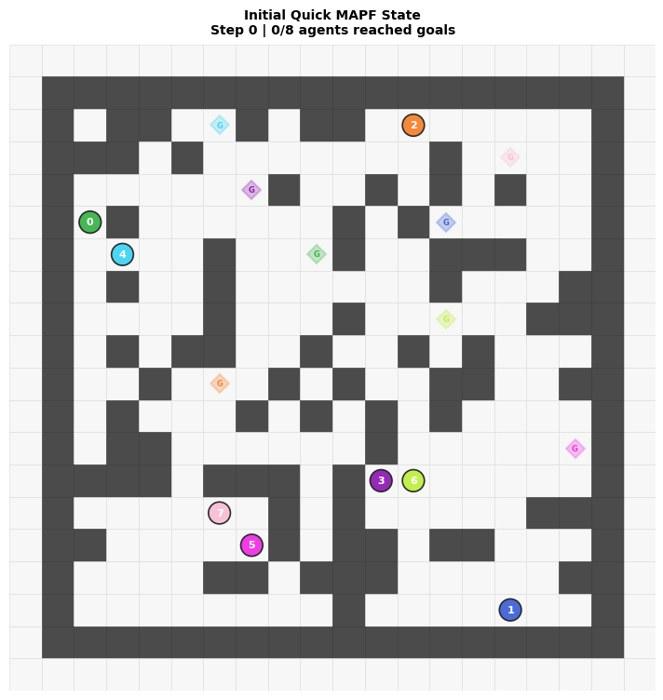
Semantic Observation Repair for Decentralized Multi-Agent Path Finding

Inference-time repair of corrupted observations for a frozen decentralized PPO policy in POGEMA, across eight corruption types (noise, dropout, bit flips, FGSM/PGD). Over 4,000 episodes, semantic projection to valid observation grids raised mean success from 68.8% to 88.2% and recovered FGSM success from 0% to 97.5% without retraining.

Figure from Semantic Observation Repair for Decentralized Multi-Agent Path Finding

MAPF, POGEMA, Adversarial Robustness

Report PDFCode

ML course

AAPR: Adversary-Adaptive Privacy-Preserving Representations

Suppressed biometric attributes (speaker identity, gender) in learned representations while keeping task utility, via a variational information bottleneck filter trained through a gradient reversal layer against a periodically re-initialized adversary. Gender leakage fell to chance but identity stayed fully recoverable.

Privacy, Information Bottleneck, Adversarial Training

CodeMethodology

Experience

  1. Aug 2025 – present

    Undergraduate Researcher

    Cognitive Assistive Robotics Lab (CARL), University of New Hampshire. Advised by Momotaz Begum.

    • Train and evaluate visuomotor policies (ACT, Diffusion Policy, DP3, flow matching, π0/π0.5, OpenVLA, GR00T) in simulation and on hardware.
    • Run real-robot studies on Franka FR3, Boston Dynamics Spot, Hello Robot Stretch 3/4, and ABB YuMi.
    • Built and maintain the Franka + Deoxys stack for teleoperation, demonstration collection, and policy evaluation, including Inspire dexterous-hand control via Quest hand tracking.
    • Supported an NIH R01 assistive-robotics deployment in a participant's home.
  2. Fall 2026

    Teaching Assistant, CS 733 Mobile Robotics

    University of New Hampshire

    • Teach ROS 2 in simulation and on the Hello Robot Stretch 3: mapping, localization, navigation, and AprilTag perception.
  3. Jun – Aug 2025

    Software Engineer Intern

    Sustainability Roundtable Inc., Boston

    • Built production features for the SBER 3.0 platform in React and TypeScript, plus internal automation that reduced manual workflow time.
  4. Spring 2025

    Teaching Assistant, CS 518 Intro to Software Engineering

    University of New Hampshire

    • Supported team software projects, answered student questions, and graded coursework.
  5. Oct 2023 – Mar 2025

    Senior Developer

    UNH InterOperability Laboratory

    • Built test automation for the NVMe conformance suite that qualifies datacenter SSDs and NVMe-oF targets: 70+ tests, 120+ issues resolved, led a test-result comparison tool, mentored junior developers.

Software projects

Software I built outside the lab. Research projects are above.

  • Semantic Codebase Graph Engine

    tree-sitter ASTs across 11+ languages plus CodeBERT embeddings to find structural and semantic code duplication.

    AST, CodeBERT, PythonCode

  • GitHub Readme Stats

    Embeddable GitHub stats cards with an Engineering Maturity model, SVG-first rendering, and deterministic caching.

    TypeScript, Next.js, SVGCodeLive site

  • Contexto Solver Agent

    Rank-weighted centroid estimation, adaptive MMR, and a learned correction to GloVe space to solve the daily word game.

    Bandits, GloVe, PythonCode

  • Your Daily Podcaster

    RSS scraping, Gemini summarization, and Cloud TTS on a scheduled pipeline that produces a daily news podcast.

    LLM, TTS, GitHub ActionsCode

  • Image Labeling & Retrieval

    Moondream2 captions, OCR, and sentence embeddings over PostgreSQL for natural-language search of a photo library.

    Retrieval, OCR, PostgreSQLCode

  • CatTracker

    Campus lost & found on Flask + Azure Blob with semantic search and real-time chat via Socket.IO.

    Flask, Azure, DockerCode

Skills

Robot Learning & ML
PyTorch, ACT, Diffusion Policy, DP3, Flow Matching, π0 / π0.5, OpenVLA, NVIDIA Isaac GR00T, Koopman Models, Sparse Autoencoders, PointNet, R3M, DINOv2, SAM2, NumPy, Pandas
Robotics & Simulation
ROS 2, Deoxys, MuJoCo, robosuite, robomimic, Meta-World, SpaceMouse Teleop, Meta Quest Teleop
Perception & Data
RealSense RGB-D, Point Clouds, Multi-Camera Calibration, AprilTags, iPhone ARKit / LiDAR, IMU, HDF5, Zarr
Languages
Python, C++, Java, TypeScript, JavaScript, Swift, Bash, MATLAB, Julia, Lean
Software & Infrastructure
React, TailwindCSS, Node.js, Flask, PostgreSQL, MySQL, MongoDB, Docker, Linux, Git, Azure, Qiskit

About

I'm Sujosh. I study how robots can learn structured models of dynamics and action, so the skills they learn compose, generalize, and stay reliable.

Education
B.S. in Computer Science, University of New Hampshire, expected May 2027. Dean's Scholar and International Engagement & Service Scholar.
Now
Undergraduate researcher in the Cognitive Assistive Robotics Lab, and teaching assistant for CS 733 Mobile Robotics this fall.
Outside the lab
Squash, cooking, chess, and percussion.
CV
Open the PDF, or type resume in the terminal.

Contact

The fastest way to reach me is email:nagsujosh2004@gmail.com. I'm happy to talk about research, robots, or anything on this page.

Durham, New Hampshire

EmailCVGoogle ScholarGitHubLinkedInXInstagram